Improve visibility across recipes, materials, tools, production, quality, traceability, costing, and finance with Microsoft Dynamics 365 Business Central for plastics manufacturing using COSMO functionality.
Naviona helps injection molders, extruders, compounders, and other plastics manufacturers replace disconnected systems and manual workarounds with a connected platform designed around how plastics operations actually run using Business Central for Plastics Manufacturing.
Turn manufacturing complexity into clearer decisions.
Discuss your current processes, priorities, and ERP environment with a senior manufacturing consultant.
Plastics Manufacturing Is Not Standard Manufacturing
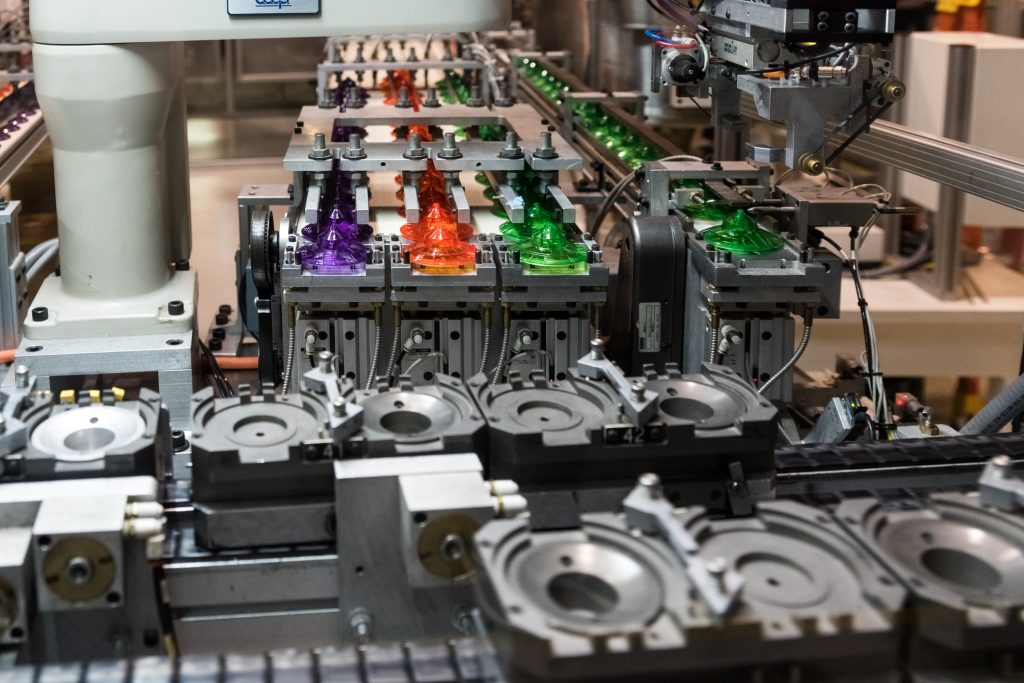
Plastics manufacturers frequently combine process, batch, discrete, and configure-to-order requirements in the same operation. Resin and additives may be blended into compounds or masterbatch, while finished products are molded, extruded, cut, assembled, packaged, and produced against customer-specific specifications.
That combination creates requirements that general ERP systems can struggle to manage without extensive spreadsheets, manual controls, or custom development. The right platform must connect the commercial, operational, quality, and financial sides of the business while preserving the flexibility needed on the plant floor.
What Plastics Manufacturers Need From a Modern ERP System
Recipe and Formula Management
Control resin, colorants, additives, fillers, regrind, and other ingredients using scalable recipes and production specifications.
Bills of Material and Routings
Support molded, extruded, fabricated, assembled, and packaged products with the correct components and production steps.
Tool, Mold, Die, and Insert Management
Connect tools and inserts to machines, production rates, cavities, cycle times, setup requirements, availability, and maintenance history.
Regrind and Scrap Control
Capture recoverable scrap, manage reclaimed materials in inventory, define allowed incorporation, and improve visibility into material yield.
Lot and Batch Traceability
Trace raw material lots into production and finished goods, then trace finished lots back to their origins when investigating quality issues or recalls.
Quality Management
Plan and record incoming, in-process, and finished-goods inspections, control nonconforming material, and manage release, quarantine, and rejection decisions.
Production Planning and Scheduling
Balance customer demand with material, machine, tooling, labor, cleaning, setup, and changeover constraints.
Accurate Manufacturing Costing
Understand resin, additives, packaging, labor, machine, setup, overhead, scrap, and by-product effects on product cost and margin.
Inventory and Warehouse Accuracy
Maintain reliable quantities and lot status across raw materials, work in process, finished goods, bulk storage, warehouses, and production locations.
Shop-Floor Data Capture and Integration
Connect operators, scanners, scales, machines, MES, quality systems, and other plant technologies to governed ERP transactions.
Customer-Specific Products and Specifications
Manage private-label packaging, customer specifications, product variants, and make-to-order requirements without losing master-data control.
Financial and Operational Visibility
Connect production activity with purchasing, sales, inventory valuation, costing, financial reporting, and decision-ready analytics.
Microsoft Dynamics 365 Business Central for Plastics Manufacturing
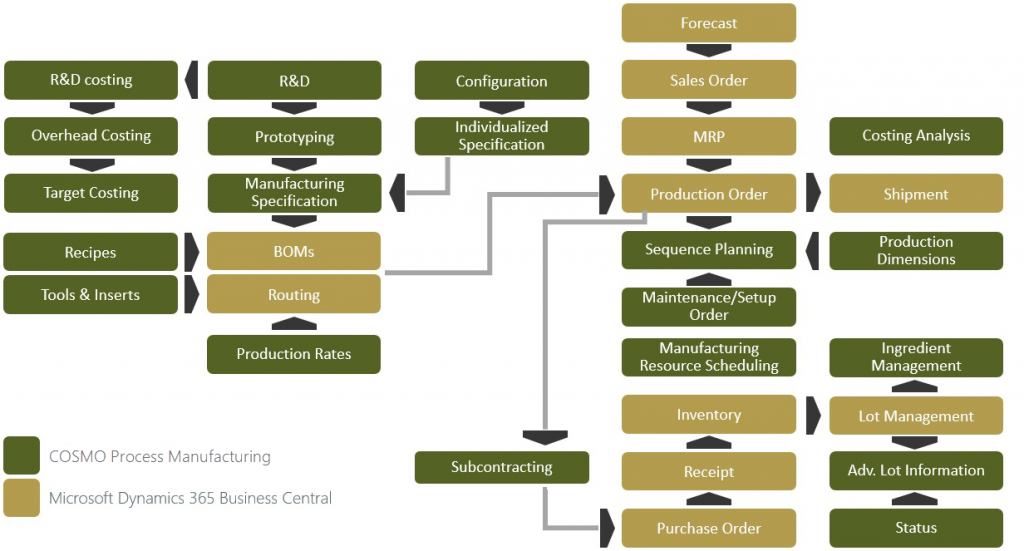
Microsoft Dynamics 365 Business Central provides the connected business foundation for financial management, sales, purchasing, inventory, warehousing, manufacturing, planning, costing, reporting, and integration. COSMO CONSULT’s manufacturing functionality extends that foundation for the batch, recipe, tool-dependent, quality-controlled, and mixed-mode processes common in plastics manufacturing.
The result is one operational platform that can connect product development, planning, production, quality, inventory, customer service, and finance instead of forcing each department to maintain its own version of the truth.
Functionality Designed Around Plastics Manufacturing
Create and manage recipes using relative ingredient shares rather than only fixed component quantities. Recipes can scale to the required batch size while preserving precision for low-volume additives and other sensitive ingredients. COSMO production structures bring recipes, bills of material, routings, process steps, quality requirements, work instructions, resources, and costs together in a coordinated manufacturing definition.
– Scale formulations for sample, pilot, or commercial quantities.
– Define when, where, and how much material is consumed during production.
– Link process stages without creating unnecessary intermediate inventory transactions.
– Separate bulk production from packaging while keeping both specifications connected.
Model the relationship between work centers, machines, tools, molds, dies, and inserts. Production rates and lead times can reflect the selected equipment and tooling combination rather than relying on a generic rate for every production order.
– Calculate production rates using cycle time and number of cavities.
– Consider tool- or insert-dependent output, sprue weight, and travel time where applicable.
– Manage tool and insert capacity when assigning production orders.
– Record tool usage, service history, and lifecycle information.
– Propose maintenance work when a tool reaches defined usage or service conditions.
Treat reusable production scrap as a controlled material stream rather than an unexplained variance. COSMO functionality can represent reclaimed items, known in plastics as regranulation, and additional outputs such as by-products or co-products that result from the same production process.
– Post reclaimed material back into inventory for reuse or separate sale.
– Define expected relationships between the primary output and reclaimed or by-product quantities.
– Automatically introduce configured additional outputs on production orders.
– Specify reclaimed-scrap rules and permitted incorporation into future production.
– Improve material-yield visibility by distinguishing loss, recoverable scrap, and usable output.
Sequence production according to operational priorities and constraints. Setup matrices can calculate different setup requirements based on the previous and next production runs, helping planners account for changes such as color, material, or tooling.
– Prioritize and resequence production as demand or plant conditions change.
– Move orders between suitable machines or split orders when needed.
– Insert cleaning, setup, and changeover jobs between production runs.
– Recalculate the dates of downstream orders when the sequence changes.
– View schedules and remaining capacity graphically by work center.
Extend manufacturing master data with user-defined production characteristics for raw materials, bulk products, finished goods, work centers, tools, and inserts. These production dimensions help represent the variability that affects material selection, manufacturing conditions, and product specifications.
Integrate quality requirements into purchasing, inventory, production, and shipping processes. Versioned test plans and inspections can support incoming goods, in-process operations, and finished products, while inventory decisions control whether lots or serial numbers are released, quarantined, or rejected.
– Embed inspections in production and supply-chain processes.
– Record test results against defined plans and specifications.
– Control the inventory status of material that is awaiting a quality decision.
– Manage nonconformities and preserve the information needed for investigation and documentation.
– Support certificate and quality-document processes where configured.
Connect raw-material lots, production batches, finished-goods lots, and customer shipments so teams can investigate genealogy in either direction. Forward tracing identifies where a source lot was used. Reverse tracing identifies which source materials contributed to a finished product or reported issue.
Evaluate product cost across development, quoting, and production using configurable calculation schemes. Costing can include ingredients, operations, setup, tools, overhead, packaging, and different lot or batch sizes, giving commercial and finance teams a clearer basis for pricing and margin decisions.
– Compare projected costs across alternative scenarios.
– Model cost degression across different production quantities.
– Roll ingredient and process costs into intermediate and finished products.
– Compare target, expected, and actual manufacturing costs.
Manage recipes, production structures, process knowledge, prototype work, costing, and the transition from development into commercial production. This creates continuity between the teams developing a product and the teams responsible for producing it consistently at scale.
Simulate production requirements for a sales quantity to review expected time, components, and material availability without changing the live production plan. This gives customer service and planning teams additional information when evaluating delivery feasibility.
Support operations that blend, compound, or prepare bulk material and then mold, extrude, fabricate, assemble, or package finished goods. Process and discrete production can remain connected through shared data, planning, traceability, costing, and financial control.
What Better Manufacturing Control Can Mean for Your Business
More reliable inventory and fewer material surprises.
Better production schedules that reflect machines, tools, materials, setup, and capacity.
Clearer visibility into scrap, regrind, yield, and material utilization.
Faster lot and batch investigations with a narrower, more defensible recall scope.
Stronger quality controls from receipt through production and shipment.
More accurate product costing and better-informed pricing decisions.
Less dependence on spreadsheets and disconnected departmental systems.
A shared operational and financial information foundation for management reporting and growth.
Designed for a Range of Plastics Manufacturing Operations
The solution approach can be adapted to manufacturers with standard products, customer-specific products, batch requirements, high-mix operations, or mixed production methods, including:
– Injection molding
– Extrusion and profile extrusion
– Film, sheet, pipe, tube, and hose production
– Blow molding and bottle production
– Compounding, masterbatch, and color concentrates
– Foam products
– Rubber and elastomer products
– Plastics fabrication, assembly, and secondary operations
– Manufacturers combining bulk, batch, discrete, and configure-to-order production
A Business Central Partner That Understands Plastics Manufacturing
Technology alone does not solve manufacturing challenges. A successful ERP initiative requires consultants who understand how inventory, production, tooling, quality, costing, traceability, and finance interact inside a plastics operation.
Naviona combines deep Microsoft Dynamics NAV and Dynamics 365 Business Central expertise with practical manufacturing experience. We begin by understanding your current processes, operational risks, reporting needs, and improvement priorities. We then design a solution that uses standard Business Central, proven COSMO CONSULT functionality, targeted integrations, and carefully selected extensions where they provide measurable value.
– Senior-led consulting throughout the engagement.
– Experience with plastics and process manufacturing requirements.
– Functional and technical Business Central expertise delivered in-house.
– Knowledge of recipes, regrind, scrap, tools, production planning, quality, inventory, traceability, and costing.
– Access to broader industry capabilities through the COSMO CONSULT partner ecosystem.
– Support for new implementations, NAV-to-Business Central migrations, upgrades, optimization, integrations, and extensions.
Start With the Manufacturing Operation, Not a Software Demo
Before recommending a solution, we work to understand how your organization sells, plans, purchases, produces, inspects, stores, ships, costs, and reports. That process helps separate requirements that fit standard Business Central from those that are better addressed with COSMO industry functionality, integration, process change, or a focused extension.
Understand
Review business goals, operational pain points, systems, data, and the processes that matter most.
Map Requirements
Document requirements across finance, sales, purchasing, inventory, production, quality, planning, and reporting.
Design the Solution
Define the role of Business Central, COSMO functionality, integrations, data migration, reporting, and extensions.
Implement and Validate
Configure, develop, migrate, test, train, and prepare the organization for a controlled go-live.
Improve Over Time
Optimize processes, reporting, automation, and user adoption as business needs evolve.
Questions Plastics Manufacturers Commonly Ask
Can Naviona help if we already use Dynamics NAV or Business Central?
Yes. Naviona supports new implementations as well as upgrades, NAV migrations, process optimization, integrations, reporting, extensions, and modernization of existing environments.
Can we trace resin lots into finished products and customer shipments?
Yes. Lot and batch information can connect purchasing, inventory, production consumption, output, and shipment transactions, supporting both forward and reverse tracing.
Can tools and molds affect production rates and scheduling?
Yes. Tool and insert relationships can influence capacity, cycle time, cavities, output, setup, and maintenance requirements. These relationships can be considered during calculation and production planning.
How can regrind be handled?
Reclaimed material can be represented as an inventory item and related to the production process as an expected additional output. Rules can also define how reclaimed material is incorporated into future production. The final design should reflect the company’s actual segregation, quality, costing, and reuse policies.
Can the system support both injection molding and batch or compounding processes?
Yes. The combined platform is intended to connect process and discrete manufacturing requirements, making it relevant for companies that compound or prepare material and then mold, extrude, assemble, or package finished products.
Do we need every COSMO module?
Not necessarily. The right scope depends on your manufacturing methods, quality requirements, current systems, and business priorities. The goal is to use the functionality that solves defined requirements without adding unnecessary complexity.
Can Business Central support plastics manufacturing?
Yes. Business Central provides a strong foundation for finance, supply chain, inventory, warehousing, production, planning, and costing. COSMO CONSULT functionality extends that foundation for plastics-oriented requirements such as recipes, mixed-mode production, advanced tooling, sequence planning, regrind, quality, and batch traceability.
Ready to Improve Visibility Across Your Plastics Manufacturing Operation?