Connect formulations, batch production, quality, traceability, compliance documentation, costing, inventory, and finance with Microsoft Dynamics 365 Business Central for chemicals manufacturing.
Naviona helps chemical manufacturers replace disconnected systems, spreadsheets, and manual handoffs with a connected chemicals manufacturing ERP platform designed for formula-based, batch-oriented, and quality-controlled operations – Business Central for Chemicals.
Turn chemical manufacturing complexity into clearer decisions.
Discuss your formulas, production processes, quality requirements, compliance needs, and ERP priorities with a senior manufacturing consultant.
Chemical Manufacturing ERP Requires More Than Standard Production Control
Chemical manufacturers must control how products are formulated, approved, produced, inspected, stored, documented, and traced. A single finished product may depend on percentage-based formulas, lot-specific ingredient characteristics, multi-stage processing, intermediate products, co-products, quality status, packaging choices, and customer or market-specific documentation.
The right ERP platform must connect research and development, purchasing, materials management, batch production, quality assurance, regulatory processes, sales, distribution, costing, and finance. It must also preserve a reliable history of what was planned, what was approved, what was used, what was produced, and where each batch was shipped.
What Chemical Manufacturers Need From a Modern ERP System
Formula and Recipe Management
Manage percentage-based formulations, ingredients, intermediates, process steps, instructions, revisions, and approved manufacturing specifications.
Batch-Oriented Production
Plan and execute blending, mixing, reacting, filling, packaging, and other batch processes with appropriate quantities, resources, and controls.
Formula Version and Change Control
Preserve approved versions, effective dates, product-development history, and a controlled transition from R&D into commercial production.
Lot and Batch Traceability
Trace raw materials, intermediates, finished batches, packaging, and customer shipments in forward and reverse directions.
Quality Management
Manage incoming, in-process, and finished-goods inspections, test plans, results, nonconformities, quarantine, release, and rejection.
Regulatory and Safety Documentation
Maintain the data and controlled documents required for products, substances, classifications, labels, safety data sheets, transport, and customer communication.
Ingredient and Substance Information
Track lot-specific and product-specific characteristics that influence formulation, quality, handling, compliance, and end use.
Scalable Batch Calculations
Convert percentage or proportional inputs into the exact weights or volumes required for the planned batch size.
Co-Products and By-Products
Represent all expected outputs of a process and allocate production quantities and costs appropriately.
Evaluate ingredients, processing, setup, overhead, packaging, batch size, and alternative scenarios from development through actual production.
Shelf Life and Expiration Control
Manage lot dates and product availability using defined shelf-life and ingredient-dependent rules where applicable.
Certificates and Customer Documentation
Generate and distribute quality and compliance documents using governed production and inspection data.
Vendor Quality and Performance
Evaluate supplier performance and use incoming inspection results to support purchasing and quality decisions.
Container and Packaging Management
Control packaging specifications and, where required, track reusable or returnable containers through the supply chain.
Integrated Operations and Finance
Connect production, inventory, quality, sales, purchasing, valuation, costing, and financial reporting in one platform.
Microsoft Dynamics 365 Business Central for Chemicals Manufacturing
Microsoft Dynamics 365 Business Central provides the connected foundation for financial management, sales, purchasing, inventory, warehousing, manufacturing, planning, costing, reporting, and integration. COSMO CONSULT extends that foundation for the formula-driven, batch-oriented, quality-controlled, and regulated processes common in chemical manufacturing.
COSMO ERP Chemicals and the related COSMO manufacturing, quality, regulatory, and hazardous-substance capabilities can connect processes from goods receipt and product development through production, inspection, release, shipment, and financial reporting. The appropriate components depend on each manufacturer’s products, markets, regulatory obligations, and operating model.
Functionality Designed Around Chemicals Manufacturing
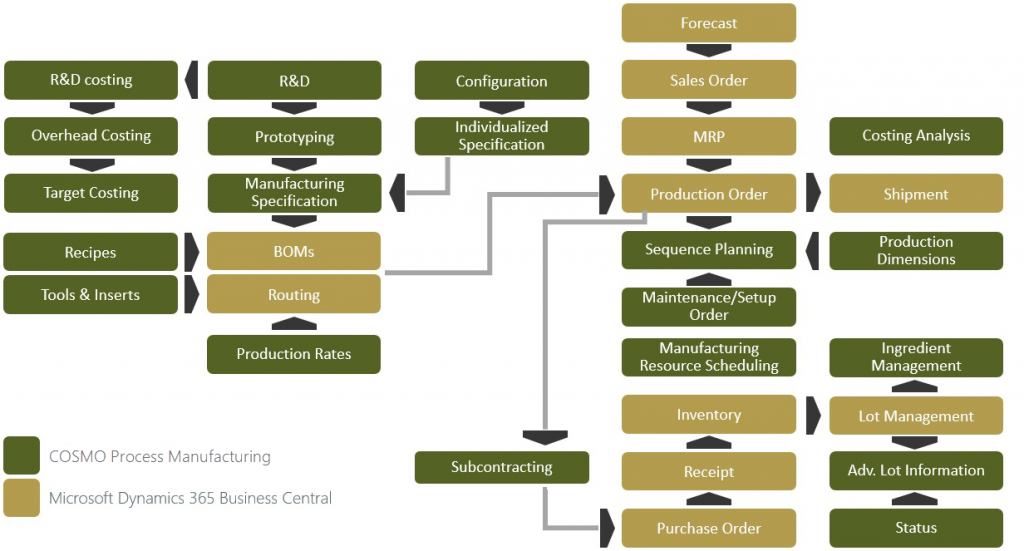
Manage formulas as relative shares or proportions and convert those inputs into exact ingredient quantities for production. Recipes can be coordinated with bills of material, routings, process stages, manufacturing instructions, quality requirements, resources, and cost information.
– Scale formulations to the required batch quantity.
– Maintain precision for ingredients used in small quantities.
– Manage multi-stage recipes and embedded process stages.
– Define where and when ingredients are added.
– Keep formulation and manufacturing instructions together in the production specification.
Use coordinated production structures to manage recipes, bills of material, routings, process actions, intermediate products, co-products, by-products, quality inspections, work instructions, and costs. Processing and packaging specifications can remain separate while still being linked through the same product and production model.
Support the progression from product concept and prototype through pilot production and commercial manufacturing. Product developers can evaluate ingredients, formulations, process options, manufacturing requirements, and projected costs before transferring approved structures into production master data.
– Maintain product and process knowledge across the lifecycle.
– Calculate theoretical and projected costs during development.
– Support prototype, sample, pilot, and commercial production stages.
– Transfer approved formulations into controlled manufacturing structures.
Represent the lot-specific or product-specific characteristics that affect ingredient proportions, quality, processing, handling, or end application. User-defined production dimensions can be associated with raw materials, bulk products, finished products, resources, tools, and other manufacturing master data.
Plan and execute mixing, blending, reacting, filling, assembly, and packaging in make-to-order, make-to-stock, or mixed-mode environments. Where processing time does not change linearly with batch quantity, fixed-step rate logic can represent defined quantity ranges and production times more accurately than simple proportional scaling.
Define additional expected outputs that result from the same manufacturing process. Configured proportions can be introduced automatically on production orders, improving visibility into output quantities and supporting a more complete representation of process yield and cost.
Embed quality inspections into purchasing, materials management, production, packaging, and shipment processes. Versioned test planning and recorded results help maintain a documented connection between specifications, inspections, inventory status, and production batches.
– Create inspections for received materials and production processes.
– Document test results against controlled test plans.
– Support in-process and finished-product inspections.
– Manage nonconformities and quality decisions.
– Use quality data as the basis for certificates and batch documentation where configured.
Control whether lots and serial numbers are available for use or shipment based on their quality status. Material can remain quarantined while inspection results are pending, then be released or rejected through defined quality processes.
Connect purchased ingredient lots, intermediate batches, production consumption, finished-product output, packaging, and customer shipments.
– Forward tracing identifies where an ingredient or source batch was used.
– Reverse tracing identifies the origins of a finished batch or reported issue.
Use manufacturing, lot, and inspection information to support controlled quality-document processes, including Certificates of Analysis when included in the configured solution.
– Reduce duplicate data entry.
– Align customer documentation with recorded test results.
– Support controlled batch documentation processes.
COSMO Hazardous Substance Management can extend the solution for chemical safety and transport documentation. COSMO describes capabilities for end-application analysis, compliance-document calculation and distribution, automated safety data sheets, and transport documents for ADR, IMO, and IATA requirements.
– Support safety data sheet generation and distribution.
– Maintain multilingual regulatory and hazardous-substance content where licensed and configured.
– Generate transport documentation for supported dangerous-goods processes.
– Connect product and formulation data with compliance-related documentation.
COSMO Regulatory Affairs can add controlled regulatory processes around product data, documents, and approvals.
– Support documented review processes.
– Define responsibilities and approvals.
– Maintain traceable approval histories.
– Support regulated information management.
Configure cost calculations that draw from ingredients, processing, setup, overhead, packaging, and production structures. Teams can compare scenarios from initial product development and target costing through expected and actual manufacturing cost.
– Compare ingredient and process alternatives.
– Evaluate different batch or lot sizes.
– Roll costs through intermediates and finished products.
– Support pricing and margin decisions with a consistent calculation structure.
Sequence operations using planned capacity and material availability while accounting for setup, cleaning, and maintenance events.
– Reprioritize production orders.
– Move or split orders as conditions change.
– Schedule setup and maintenance activities.
– View schedules and capacity graphically.
Coordinate personnel resources with production requirements using availability, skills, qualifications, certifications, or other defined criteria. This connects workforce constraints with the wider production schedule rather than treating labor as unlimited capacity.
Simulate production for a requested quantity to review expected time, component quantities, and material availability without changing the current production plan.
– Evaluate production feasibility.
– Review material availability.
– Support planning and customer-service decisions.
COSMO supplier-evaluation functionality can use an objective points approach and delivery-history information to assess vendors over configured evaluation periods.
– Evaluate supplier performance consistently.
– Support purchasing decisions.
– Improve supplier quality management.
– Reduce separate data maintenance.
For manufacturers that ship in reusable packaging or containers, COSMO functionality can manage distribution, customer-account inventory, and container returns.
– Track returnable assets.
– Monitor customer-held containers.
– Improve visibility across the supply chain.
Business Central web services and related COSMO integration, factory data capture, and mobile capabilities can connect electronic devices and operational systems with ERP processes.
– Connect LIMS, MES, SCADA, historian, and operational systems.
– Integrate factory data capture processes.
– Govern ERP transactions and manufacturing references.
– Improve visibility between plant-floor and business systems.
What Better Chemical Manufacturing Control Can Mean for Your Business
– More consistent formulas, specifications, and manufacturing instructions.
– Better control over product revisions and the transition from R&D to production.
– More reliable batch planning and material calculations.
– Faster forward and reverse traceability investigations.
– Stronger quality controls across receipt, production, inventory, and shipment.
– Clearer quarantine, release, rejection, and nonconformity processes.
– More consistent quality, safety, and customer documentation.
– Better visibility into ingredient, processing, packaging, and overhead cost.
– Less dependence on spreadsheets and disconnected departmental databases.
– A shared operational and financial foundation for reporting, audit support, and growth.
Designed for a Range of Chemical Manufacturing Operations
The solution approach can be adapted to formula-driven and batch-oriented organizations with varying quality, packaging, traceability, and regulatory requirements, including:
– Industrial organic and inorganic chemicals
– Specialty chemicals
– Coatings, paints, inks, varnishes, and adhesives
– Pigments, colorants, additives, and concentrates
– Cleaning chemicals and detergents
– Agricultural chemicals
– Biocides and treatment products
– Construction chemicals
– Lubricants and related formulated products
– Chemical distributors with light manufacturing, blending, filling, or repackaging
– Manufacturers combining batch processing with filling, packaging, assembly, or customer-specific configuration
A Business Central Partner That Understands Chemical Manufacturing
Technology alone does not solve manufacturing complexity. A successful ERP initiative requires consultants who understand how formulations, ingredients, batch production, quality, traceability, compliance, costing, inventory, and finance interact inside a chemical operation.
Naviona combines deep Microsoft Dynamics NAV and Dynamics 365 Business Central expertise with process-manufacturing experience. We begin by understanding your products, markets, current systems, operational risks, documentation requirements, and improvement priorities. We then design a solution using standard Business Central, proven COSMO CONSULT capabilities, targeted integrations, and carefully selected extensions where they provide measurable value.
– Senior-led consultants throughout every engagement.
– Manufacturing-first experience across process-oriented environments.
– Functional and technical Business Central expertise delivered in-house.
– Practical knowledge of formulas, batch production, quality, traceability, inventory, costing, and reporting.
– Access to broader industry capabilities through the COSMO CONSULT partner ecosystem.
– Support for implementations, NAV migrations, upgrades, optimization, integrations, reporting, and extensions.
Start With the Manufacturing Operation, Not a Software Demo
Before recommending a solution, we work to understand how your organization sells, plans, purchases, produces, inspects, stores, ships, costs, and reports. That process helps separate requirements that fit standard Business Central from those that are better addressed with COSMO industry functionality, integration, process change, or a focused extension.
Understand
Review business goals, operational pain points, systems, data, and the processes that matter most.
Map Requirements
Document requirements across finance, sales, purchasing, inventory, production, quality, planning, and reporting.
Design the Solution
Define the role of Business Central, COSMO functionality, integrations, data migration, reporting, and extensions.
Implement and Validate
Configure, develop, migrate, test, train, and prepare the organization for a controlled go-live.
Improve Over Time
Optimize processes, reporting, automation, and user adoption as business needs evolve.
Questions Chemical Manufacturers Commonly Ask
Can Naviona help if we already use Dynamics NAV or Business Central?
Yes. Naviona supports new implementations as well as upgrades, NAV migrations, process optimization, integrations, reporting, extensions, and modernization of existing environments.
Can the solution produce safety data sheets and dangerous-goods documents?
COSMO Hazardous Substance Management is described as supporting automated safety data sheets and transport documents for ADR, IMO, and IATA processes. Applicability depends on the licensed solution, configured content, products, markets, and regulatory requirements.
Can we trace ingredients into finished batches and customer shipments?
Yes. Forward and reverse batch tracing can connect source materials, production batches, finished output, and downstream shipments.
Can material be quarantined until quality testing is complete?
COSMO quality capabilities support inventory availability decisions and the status of lots or serial numbers, including quarantine, release, and rejection processes.
Can the system manage formula revisions and product development?
COSMO Process Manufacturing includes research-and-development and production-structure capabilities that support the product lifecycle from development and prototypes into commercial production.
Can formulas be maintained as percentages and scaled to a batch?
Yes. COSMO recipe functionality supports relative shares and converts the formulation into production quantities for the selected output or batch quantity.
Do we need every COSMO component?
No. The appropriate components depend on the company’s products, processes, markets, quality system, regulatory obligations, and priorities. Scope should be matched to documented requirements.
Can Business Central support chemical manufacturing?
Business Central provides the foundation for finance, supply chain, inventory, warehousing, manufacturing, planning, and costing. COSMO extends that foundation for formula management, batch production, quality assurance, traceability, specialized costing, and related chemical-industry processes.
Ready to Improve Visibility Across Your Chemical Manufacturing Operation?